.jpg)




July 2, 2009: A Critical Day for Vancouver Airspace
Nav Canada's consultation process is over and the proposed changes for Vancouver VFR Terminal Area (VVTA) will become law, effective July 2, 2009. The 17 flight schools or so that utilize the lower mainland's VFR space—as well as the hundreds of recreational and sport pilots—will now be squeezed even further to the narrowing corridor along the Fraser River, and just to make it exciting for those involved, Nav Canada is throwing low-altitude, high-speed jet traffic into the mix, right along what is the busiest air corridor in Canada—the Fraser River Corridor north of Sumas Mountain.
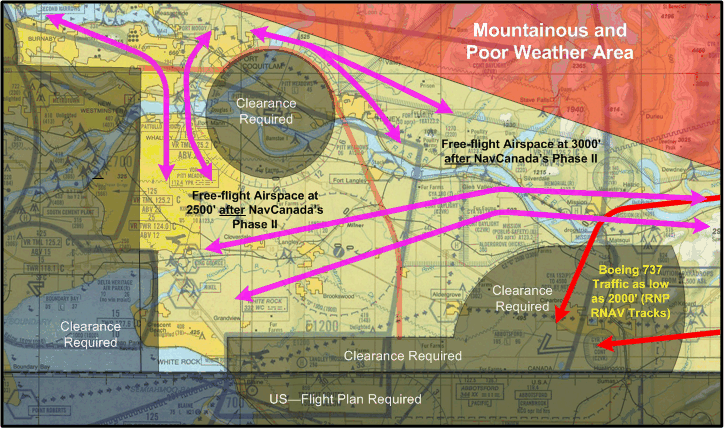
For those of us who have witnessed the transition from Class D to Class C Control Zones at Langley and Pitt Meadows over the year and a half, we are aware of the struggle experienced by our short-staffed controllers attempting to keep up with the higher level of service—we have heard the all too frequent "remain clear of the zone" and we have experienced the denial of access to circuit training. Many of us, then, don't have a lot of faith in Class C Control Zones as far as predictable access to airspace resources is concerned. Now, Nav Canada has extended Pitt and Abby’s Class C up to the floor of the Terminal Class C airspace. With the restricted access to US Airspace to the south, and the mountainous areas to the north (commonly shrouded in IFR and MVFR weather), we're all going to be zipping east and west along the Fraser River corridor like fish caught tidal pools on White Rock beach. And, if the risk of a mid-air collision is not high enough already, Nav Canada and Transport Canada are going ahead with its authorization of RNP RNAV high-speed descents by WestJet down to as low as 2000' along the Fraser River between Chilliwack and Mission.
What is Nav Canada's rationale for the vertical expansion of the Pitt Meadows and Abbotsford Control Zones? Why are they reducing the free-flight airspace between Vancouver and Chilliwack by 20%? Nav Canada says it must undertake this unprecedented expansion in restrictions to protect the parachute jumping operations.
Who says jumpers and pilots can't co-exist without Class C? What are CYAs for in Canada? Are collisions between jumpers and aircraft frequent? What study of the risk of collision between jumper and pilot does Nav Canada refer to in support of these Class C walls? Has Nav Canada conducted a study of the countervailing risk of aircraft-aircraft collision along a further restricted Fraser River corridor?
Make no mistake, the stakes are very high. We need only recall the very sad and tragic Cloverdale Mid-air Collision to fully appreciate this. Nav Canada's consultation process with the public has come to an end. The special interest groups have exerted their influence, and the July changes are law. But there is one remaining avenue of redress that can still be pursued. If you view the proposed changes as a hazzard to flight training and gneral avaition safety, you can still voice your concerns to Transport Canada—that branch of our government that has the final say on air safety. The senior civil servant for Transport Canada is Louis Ranger, Deputy Minister, and Louis can be e-mailed at louis.ranger@tc.gc.ca. When you contact Louis, remember the families of the pilots and student pilots who will be forced to fly the narrow Fraser River corridor created on July 2nd.
Here are some suggestions you might consider making:
- Know that free-flight airspace has to be expanded—not contracted—so as to deal with increase private/sport and training traffic over the lower mainland.
- Move the floor of the TCA Class C up to 5,500' west of the Langley Control Zone and along the Fraser River from Second Narrows Bridge to the Mission Bridge.
- Keep the free-flight space above the Abby and Pitt zones so as to avoid constricted corridor over the Fraser River.
- Develop a CYA for the Pitt jumpers.
- Publish discrete frequencies for communications with jump aircraft so that up-to-the-minute information can be relayed to vicinity aircraft (warning "minute back" broadcasts of jumpers in the air).
- Convey to pilots through NOTAMs more accurate information related to to CYA use for jumpers—not just the blanket times previously used.
- Negotiate open access to US airspace north of Bellingham, including designated training airspace.
- Keep WestJet's high-speed arrivals to Abbotsford south of that airport, and well clear of the Chilliwack-Vancouver corridor.
- Encourage the submission of CADORs (formal Nav Canada reporting) on aircraft-aircraft and aircraft-jumper near misses so as to keep tabs of the problem and risk.