.jpg)




Nav Canada's changes for Vancouver Airspace—Collision Risk goes up, as Water in the Fish Bowl goes down.
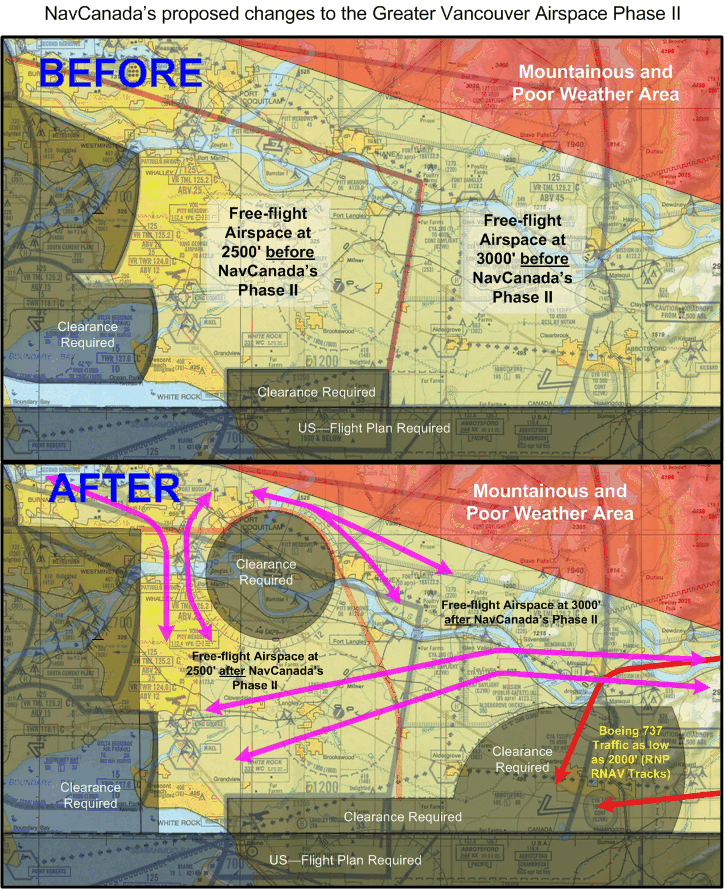
Highlights of Nav Canada’s airspace changes effective July 2, 2009:
Feature Change |
Rationale for the Change |
Criticism of the Change |
Overall reduction of free-flight airspace |
Need to expand Mode C control zones of Pitt Meadows and Abbotsford so as to protect parachute jumpers. By requiring a clearance of all aircraft entering these expanded control zones, ATC can ensure positive separation between jumpers and aircraft. |
Outside the mountainous areas, this reduction amounts to as much as 20% of the free-flight airspace in the Vancouver-Chilliwack Corridor. As free-flight airspace diminishes, there is an increase in the risk of midair collisions—“less water in the fish bowl."
Expanded control zones present an effective barrier to aircraft as overflight without a clearance is prohibited—this results in the compression of transient air traffic along dangerous corridors.
Substantial loss of free-flight airspace above Abbotsford and Pitt Meadows airports improperly undertaken to facilitate small interest groups—two commercial parachute operations.
CYAs provide adaquate protection for parachute activity; the planned use of extending Class C airspace for this role is misguided use of a scarce public resource (free-flight airspace).
|
Mode C transponders required for all flights above 1500’ as far east as Harrison Hot Springs |
Boeing jet traffic arriving on Abbotsford’s Runway 19 and 25 will be descending to as low as 2,500’ along the Fraser River and Mode C requirements will enhance the Boeing pilots’ reliance on TCAS for traffic separation. |
The procedure of descending Boeing jet traffic over the Fraser River to altitudes as low as 2000’ on RNP RNAV approaches is an unacceptable mitigation of risk by NavCanada and Transport Canada. Because light aircraft will no longer transition east-west above the Abbotsford control zone, they will be forced to transition along the Fraser River in the vicinity of the arrival RNP tracks.
RNP tracks provide safe terrain separation, but make no provision for traffic separation. RNP tracks into Abbotsford Airport should be restricted to comparatively less-dense airspace south of the localizer for Runway 07.
This increased risk of collision resulting from this change is accepted by Nav Canada solely for the purpose of saving passenger jet operators a few minutes flying time—is this acceptable risk mitigation? Hopefully we won't have to wait for a civil lawsuit to address this question.
|
A corridor for east-west transition south of Boundary Bay airport is replaced with an expanded “square” control zone.
|
No rationale. |
Free-flight airspace in the lower mainland is too scarce a public commodity—if Nav Canada needs to convert free-flight airspace around the Boundary Bay Airport to clearance-required airspace, the public should be provided with sound operational reasons as to why this is necessary.
|
The ceiling of the "Glen Valley Practice Area"— CYA 180 (T) and CYA 181 (A)(T)—will return to 5500' for both the east and west sections.
|
NavCanada has re-evaluated its need for this top 1000' feet in this sector and it is no longer required for IFR operations.. |
If the layer between 4500' and 5500' is not needed in the Glen Valley Practice Area, then the floor of the TCA throughout the sector in which Glen Valley is located should be raised from 4500' to 5500'.
|
Further Reference:
- NavCanada is no longer consulting stakeholders on these changes so any concerns must now be directed along politcal avenues. The senior civil servant for Transport Canada is Louis Ranger, Deputy Minister (Phone: 613-990-4507;
FAX: 613-991-0851; E-mail: louis.ranger@tc.gc.ca).
- See the President's Message for further discussion on the proposed changes, including suggested alternate course of action.
- NavCanada's draft VTA (currently there is no web-based information on the July changes published by NavCanada, other than the draft VTA).
- More on RNP RNAV (FAA Video).
- If you have comments or opinions on the proposed NavCanada changes and wish to post them on this webpage, contact cfi@langleyflyingschool.com.