.jpg)




This brief oulines the restrictions on flight operations arriving and departing at Langley Airport for the Olympics; they will be in effect for the period January 29 to March 16, 2010.
The following rules, including the depicted "Olympic Rings" are derived from the NavCanada's VANCOUVER 2010 OLYMPICS - Olympic Rules and Information (AIP CANADA (ICAO) SUPPLEMENT 35/09)
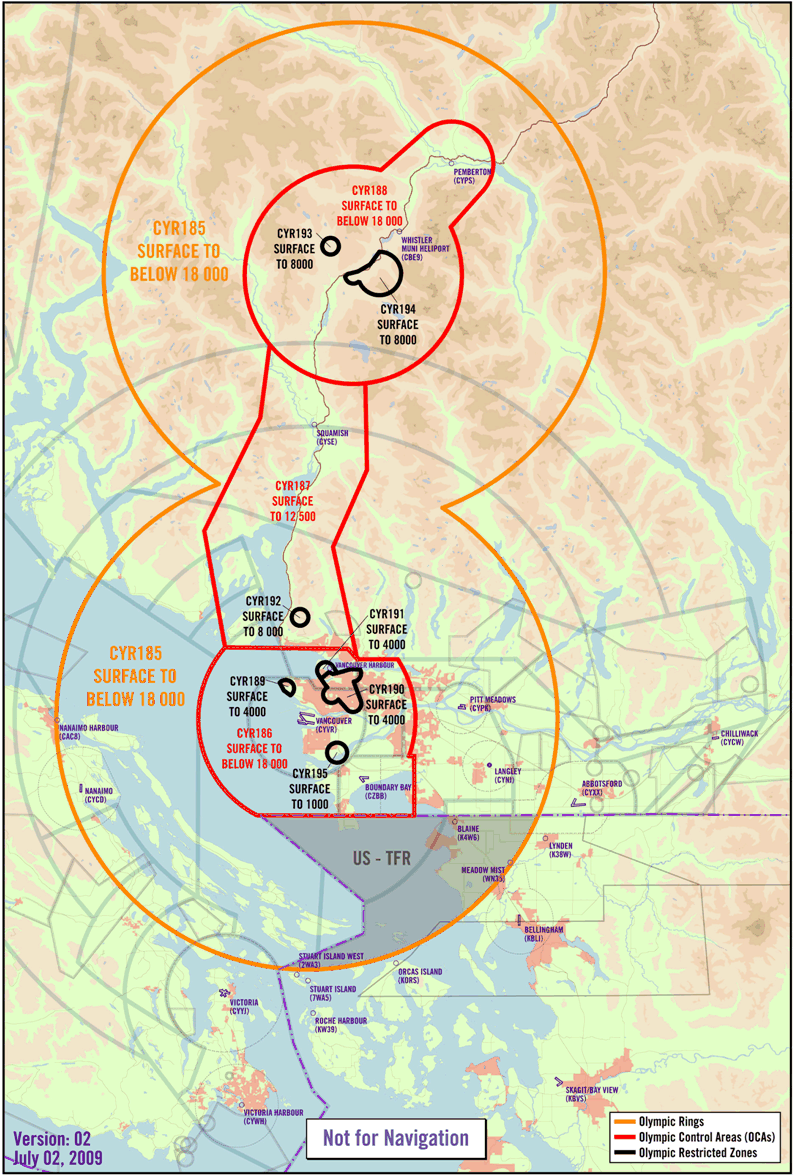
OPERATING RULES AND PROCEDURES—CYR185 (Langley and Pitt Meadows Airports)
- All aircraft except for approved military and police operations will be required to be on an active IFR or VFR flight plan; no flight itineraries will be accepted. Flight plans must specify point-to-point operations. Random flights within CYR185 will not be authorized.
- All aircraft will require a functioning transponder and will be required to squawk a discrete transponder code assigned by NAV CANADA prior to departure and at all times while operating within CYR185.
- All aircraft entering and operating within CYR185 will be required to establish and maintain two-way radio communications with air traffic services (ATS). Applicable VFR frequencies will be published on Supplemental Olympic Charts, which will be available in October 2009.
- The following operations will be prohibited within CYR185:
- − solo flights by student pilots;
- − aerobatic flights, including stalls, spins and steep turns;
- − forced landing and precautionary landing practice;
- − unmanned air vehicles (UAV) and model aircraft operations.
All traffic within CYR185 will be monitored by surveillance radar and any unauthorized aerial activity within the restricted airspace will be subject to intercept by military aircraft. It is incumbent on all aviators to review the Canada Flight Supplement (CFS), Section F—Emergency—Interception of Civil Aircraft, to ensure they know and understand their responsibilities if intercepted.
FLIGHT PLANNING—CYR185
All aircraft intending to operate within CYR185 will be required to be on an active IFR or VFR flight plan. To avoid delays, flight plans should be filed at least 60 min prior to departure. Flight itineraries will not be accepted. In addition, no random flights will be allowed within CYR185; point-to-point operations must be specified within the flight plan.
For example:
Departure Aerodrome: CYPK (Pitt Meadows)
Route: DCT CYNJ (Langley) DCT
Destination Aerodrome: CYXX (Abbottsford)
Remarks: One circuit (touch-and-go) at CYNJ
All pilots departing within CYR185, or intending to enter CYR185, must also obtain a discrete transponder code prior to departure. If this code is not assigned, or is unavailable when the flight plan is filed, pilots must contact the Vancouver area control center (ACC) (NAV CANADA), at 1-866-998-2010, prior to departure in order to be assigned a discrete transponder code. This number should also be used for general Olympic flight plan inquiries.
In accordance with current procedures, IFR flights will be assigned a discrete transponder code upon receiving their IFR departure clearance.
The same flight planning and transponder code requirements will apply to CYR186, CYR187 and CYR188.
GENERAL OPERATING RULES AND PROCEDURES—CYR186, CYR187 AND CYR188 (Boundary Bay Airport)
- All aircraft except for approved military and police operations will be required to be on an active IFR or VFR flight plan; no flight itineraries will be accepted. Flight plans must specify point-to-point operations. Random flights will not be authorized.
- All aircraft will require a functioning transponder and will be required to squawk a discrete transponder code assigned by NAV CANADA prior to departure and at all times while operating within the airspace.
- All aircraft entering and operating within the airspace will be required to establish and maintain two-way radio communications with ATS. Applicable VFR frequencies will be published on Supplemental Olympic Charts, which will be available in October 2009.
- All aircrew will be required to register with the Vancouver 2010 Integrated Security Unit (V2010 ISU). Additional information will be published on the ISU Aviation Planning Web site, which is scheduled to be activated in August 2009.
- Operators and/or flight crew will be required to submit a flight authorization request to the V2010 ISU for each flight, except for scheduled passenger-carrying flights (Canadian Aviation Regulation [CAR] 705) that meet the requirements of the Air Carrier Security Measures.
- All persons, including aircrew, and goods will be required to be screened in accordance with Transport Canada regulations, orders, measures and directions.
- The following operations will be prohibited within the Olympic control areas:
- parachuting
- parasailing
- paragliding
- hang gliding
- rocket launches
- radio-controlled aircraft
- UAVs
- hot air balloons
- dirigible aircraft
- agricultural operations
- sight-seeing
- aerial advertising/banner towing
- flight training, except for circuit training authorized by V2010 ISU at Boundary Bay Airport (CZBB), and
- general aviation, except for arrivals and departures at Boundary Bay Airport (CZBB) authorized by V2010 ISU.
All traffic within the airspace will be monitored by surveillance radar and any unauthorized aerial activity within the restricted airspace will be subject to intercept by military aircraft. It is incumbent on all aviators to review the CFS, Section F—Emergency—Interception of Civil Aircraft, to ensure they know and understand their responsibilities if intercepted.