.jpg)



Flight Rules and Safety Precautions
- Flight Rules and Safety Precautions
- Requirements for Flight Preparation
- Post-flight Requirements
- Weather Minima Requirements
- Altitude Minima Requirements
- Additional Requirements for Spin Training
- Additional Requirements for Strait of Georgia Flights
- Additional Requirements for IFR Flight Training
- Additional Requirements for Multi-engine Flight Training
- Requirements for Collision Avoidance
- General Requirements
Record of Amendment
- December 29, 2019: Cannabis and Illegal Drug Consumption Policy added.
- December 29, 2019: Abnormal Occurence Report policy amended to include possible ATC clearance and airspace regulation contravention.
- December 1, 2019: Collision avoidance procedures in prolonged climbs amended to incorporate ATC restrictions.
- July 18, 2018: Landing authorization restricted to Certified Airports, except in emergency, or with CFI prior permission.
- July 30, 2017: Clearance readback requirements amended to include madatory readback of altitude restrictions.
- May 31, 2017: Runway clearance readback requirements amended.
- May 27, 2017: Aircraft post-flight security amended to specify requirements for single-engine aircraft.
- April, 2017: Cessna 172 included in spin maneuver requirements.
- December 22, 2015: Minimum spin entry and recovery altitude for Cessna 152 increased to 5000' and 4000' respectively.
- June 22, 2014: Addition of a Violation Provision.
- December, 2013: Cross-reference to Georgia Strait requirements placed in Weather Minimum.
- December, 2013: Pre-boarding Inspection requirements imported from Standard Operating Procedures.
- November, 2013: Altitude minima established for upper air maneuvers.
- November, 2013: Minimum ridge crossing altitude in a mountainous area and minimum altitude over water specified.
- November, 2013: Additional requirements for spin training introduced.
- October, 2013: Collision Avoidance maneuvers during prolonged climbing amended.
Requirements for Flight Preparation
Flight Briefing
- Before each flight, student pilots shall contact the Kamloops Flight Information Centre at 1-866-992-7433 (WX BRIEF) and obtain a pilot briefing. From this briefing, a student must determine forecast cloud layers, visibility, wind, temperature, turbulence, SIGMETS (Significant Weather Reports) and NOTAMs (Notice to Airmen) for the departure and destination airport, and the proposed training area or route.
- Prior to each training flight (dual or solo), student pilots shall examine the aircraft Journey Log and the Langley Flying School’s Aircraft Status Display to ensure:
- the total air time reported on the Aircraft Status Display accurately reflects the total air time recorded in the aircraft Journey Log prior to the first flight of the current day;
- the date and/or air time of scheduled maintenance tasks for aircraft posted on the Aircraft Status Display have not been exceeded;
- they have knowledge of any current deferred aircraft defects.
Revision 13-01
Ramp Safety
Prior to conducting pre-flight servicing or inspection of training aircraft, student pilots shall ensure the aircraft ignition keys are visibly placed on the aircraft’s glare shield, thereby ensuring the magnetos are switched off.
Revision 13-01
Fuel and Oil
- Prior to each training flight (dual or solo), student pilots shall record the quantities of fuel and oil on board the aircraft at the time of takeoff in the Training Flight Operations Log. The fuel must be specified in U.S. gallons and time (normal cruise fuel consumption); the oil must be specified in U.S. quarts.
- For VFR training flights, fuel and oil must be sufficient for the intended flight, plus 60 minutes at normal fuel consumption.
- Oil shall be added when the indicated quantity is at or below the following: in the case of the Cessna 150/152, add at 5 quarts U.S.; in the case of the Piper Cherokee and Piper Seneca, add at 6 quarts U.S.
Revision 13-02
Weight and Balance Control
Prior to each flight student pilots shall calculate the proposed takeoff weight and Centre of Gravity of the training aircraft and record these in the Training Flight Operations Log.
Revision 13-01
Flight Authorizaton
-
Prior to each training flight (dual or solo), the entry in the Training Flight Operations Log shall be countersigned by a supervising instructor.
Revision 13-01
Pre-boarding Inspection
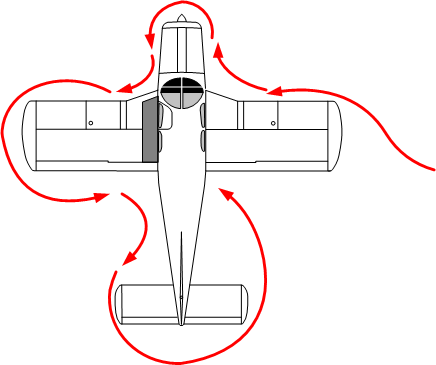
Prior to boarding an aircraft for the purpose of conducting an engine start, student pilots and rental pilots will walkabout the aircraft to visually check the following: fuel cap security, fuel sump valve security (no leaks), tires and brakes (normal appearance, no hydraulic leaks), engine cowling latches (secure), and a last inspection for external airframe damage.
Revision 13-01
Post-flight Requirements
Aircraft Security
At the termination of each flight, student pilots shall ensure their aircraft is properly positioned and secured so as to prevent collision or wind damage. When a parked aircraft is not under constant and direct supervision by a Flight Instructor or Pilot-in-command, single-engine aircraft must be tied down and the control column secured. In all cases, the control column of an unoccupied aircraft must be secured when the surface winds are in excess of 7 KTS.
Revision 13-01
Aircraft Time Records
At the termination of each training flight, student pilots shall ensure the aircraft start-up and shutdown Hobbs times, and the aircraft takeoff and landing times, are recorded in the Training Flight Operations Log.
Revision 13-01
Weather Minima Requirements
Dual Flight Training
- All dual flights are governed by the weather minima specified in the Canadian Aviation Regulations.
- While active VFR flight training is prohibited when below the above weather minima, Flight Instructors may operate with Special VFR authorization owing to localized phenomena during arrivals and departure.
Revision 13-01
Solo Flight Training
- The application of weather minima is based on the following forcast publications: circuit training is governed by the Langley ATIS and the Abbotsford Terminal Aerodrome Forecast, non-circuit training is governed by the Abbotsford Terminal Aerodrome Forecast, and Cross-country flights are govened by the applicable Geographic Area Forecast.
- The following minimum apply to solo flights:
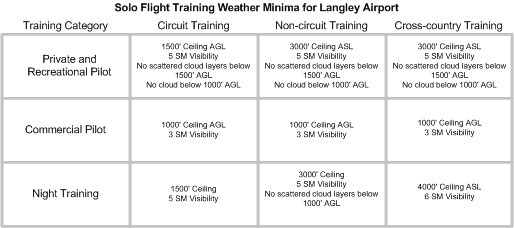
See additional weather minima for dual and solo flights over and along the Strait of Georgia, below.
Revision 13-03
Altitude Minima Requirements
Terrain Rules
- Unless otherwise indicated in this section, all training flights are governed by the altitude minima specified in the In CAR 602.14 and CAR 602.15 of the Canadian Aviation Regulations.
- Unless authorized by a supervising Flight Instructor, solo flights are prohibited below 500' AGL.
- The minimum ridge crossing altitude in a mountainous area is 500' AGL.
- The minimum altitude over water is sufficiently high to enable maximum distance glide to land with the aircraft propeller windmilling.
Revision 13-02
Maneuver Rules
- The minimum altitude for solo slow flight practice is 2500' AGL.
- The minimum entry altitude for solo stall practice is 3000' AGL and the minimum recovery altitude is 2000' AGL.
- The minimum entry altitude for spin practice in the Piper Cherokee 140 is 4000' AGL and the minimum recovery altitude is 3000' AGL; the minimum entry altitude for spin practice in the Cessna 152 and 172 is 5000' AGL and the minimum recovery altitude is 4000' AGL
Revision 15-01
Additional Requirements for Spin Training
- As part of the safety precautions taken immediately prior to entering a spin maneuver, the Pilot-in-command will physically ensure the seat harnesses are attached and secure.
- Solo spin training is prohibited for non-commercial pilot training.
- Solo spin training for commercial pilot training is prohibited unless specifically authorized by the supervising instructor.
- The maximum number of intentional spin rotations during spin training for non-flight instructor training is one 360°; the maximum number of intentional spin rotations during spin training for instructor rating training is two 360°.
- For two-rotation spins conducted during instructor rating training, the minimum entry altitude is 5000' AGL and the minimum recovery altitude is 3000' AGL.
Revision 13-02
Additional Requirements for Strait of Georgia Flights
- Dual or solo flight across or along the Strait of Georgia, the forecast weather minima is no cloud ceiling below 6,000’ ASL, no precipitation, and a minimum (15) miles visibility.
- Flight altitude over the Strait of Georgia must at all times be sufficiently high to enable maximum distance glide to land with the aircraft propeller windmilling.
- Belt-mounted life jackets must be worn by all persons on board single-engine aircraft during Strait of Georgia crossings.
Revision 13-01
Additional Requirements for IFR Flight Training
- For IFR training flights, fuel and oil must be sufficient for flight to the intended destination, and hence from the destination airport to the alternate airport, plus 45 minutes at normal fuel consumption.
- The weather minima for single-engine IFR flight training shall be sufficiently high so as to permit a successful forced approach during the course of flight, and at no time less than a 700’ ceiling AGL and three (3) miles visibility. For multi-engine IFR flight training, the weather minimum shall be as published for IFR flight in the Canadian Aviation Regulations.
- IFR flight training at altitudes above the freezing level in Instrument Meteorological Conditions (IMC) is prohibited.
Revision 13-01
Additional Requirements for Multi-engine Flight Training
- Prior to pre-flight services or inspection, a visual inspection of the magneto switches shall be made to ensure they are switched off.
- It is prohibited to conduct a takeoff when Accelerate-Stop Distance exceeds Takeoff Run Available.
- A pre-takeoff briefing must be conducted or supervised by the Pilot-in-Command just prior to all departures which specifies:
- the target speeds, flap configuration, and gear retraction procedures to be used during the takeoff; and
- the actions that will be taken in the event of an engine failure on departure, with specific reference to Vmc and the anticipated landing area available.
- With respect to stall training, the aircraft must be at an operationally safe altitude so as to permit recovery at or above 3000’ AGL.
- It is prohibited to initiate a simulated engine failure below 500’ AGL, unless authorized by Chief Flying Instructor.
- It is prohibited to demonstrate Vmc below 4000’ AGL.
- All training involving actual engine shutdown must occur within 15 miles of the following airports: Abbotsford, Pitt Meadows, Boundary Bay, or Bellingham. The conditions at the selected airport must be suitable for a landing in the event that the engine cannot be restarted.
Revision 13-01
Requirements for Collision Avoidance
- Prior to executing a turn during flight, students receiving dual instruction shall visually inspect vicinity airspace for traffic and call “clear left” in the case of left turns, or “clear right” in the case of right turns.
- During prolonged climbs or descents, and with due with ATC restrictions, students shall conduct periodic heading changes not less than 30° to visually inspect vicinity airspace for traffic.
- A clearing turn to inspect vicinity airspace for traffic shall be conducted prior to each stall, spin, and prior to slow flight manoeuvring. This clearing turn must consist of a 180° turn, or two 90° turns in opposite directions, and shall be conducted immediately prior to conducting the manoeuvre.
Revision 19-01
General Requirements
Aircraft Defects and Unserviceabilities
All aircraft defects and unserviceabilities will be immediately reported to the supervising instructor and entered in the aircraft Journey Log.
Revision 13-01
Abnormal Occurrence
For the purpose of safe flight operations, including the possible need for a safety inspection of aircraft, any of the following incidents shall be immediately reported to the supervising instructor:
- An accident where a person is hurt or incurred as a result of the operation of the aircraft;
- An accident where an aircraft is damaged or possibly damaged as a result of the operations of the aircraft or vehicle;
- An abnormal occurrence, including:
- abnormally hard landings, nose-wheel landings, or landings involving tail strikes or excessive side-loading on the landing gear;
- bird strikes or possible bird strikes;
- collision or possible collision with any object during ground or flight operation;
- flap deployment in excess of the limit speeds specified for the aircraft;
- airspeed in excess of the maximum structural cruise speed;
- the exceeding of any other aircraft limitation prescribed by the Pilot Operating Handbook;
- non-compliance/possible non-compliance or confusion with an ATC clearance or instruction;
- non-compliance or possible non-compliance with an airspace regulation;
- niolation or possible violation of a Canadian Aviation Regulation.
Students are reminded that incidents are reviewed for the purpose of assessing how the risk of re-occurrence can be minimized. There is no intent to assess blame or fault. Open communication of abnormal occurrence is crucial for effective flight safety.
Revision 19-01
Practice Area
Except in an emergency, and unless otherwise specified by the Flight Instructor authorizing the flight, the practice areas for all Private Pilot and Recreational Pilot solo training flights is CYA 188 (A)(T).
Revision 13-01
Crosswind Limit
For all Private Pilot and Recreational Pilot solo training flights, the maximum crosswind component for conducting takeoffs or landings is 10 knots. For all other training flights, takeoffs are prohibited where the wind conditions exceed the maximum demonstrated crosswind component published in the Pilot Operating Handbook or placarded in the aircraft.
Revision 13-01
Temperature Limit
The minimum temperature for all training flights originating from Langley Airport is -20° C.
Revision 13-01
Clearance Read-back Requirements
All runway clearances from a Tower Control Unit pertaining to lining up to wait for take off clearance, or a takeoff clearance, must be read back.
All altitude restrictions assigned by a Tower Control Unit must be read back
Revision 17-01
Aircraft Lighting
The landing light of single-engine aircraft shall be turned on during all flights.
Revision 13-01
Wildlife Runway Restrictions
- Takeoffs or landings are prohibited when birds are situated on the runway surface.
- Takeoffs or landings are prohibited when coyotes are located within 500' of a runway surface.
Revision 13-02
Unscheduled or forced landing
In the case of an unscheduled or forced landing, the pilot-in-command (student pilot or instructor) must contact Flight Service, either by radio (121.5 MHz.) or by ground line (the Kamloops Flight Information Centre at 1-866-992-7433—WX BRIEF) and the Chief Flying Instructor. Except in the case of an emergency, no attempt shall be made to take off after an unscheduled or forced landing without the approval of the Chief Flying Instructor.
Revision 13-01
Airport Restrictions
Except in emergencies, or with prior permission from the Chief Flying Instructor, landings are only permitted at airports certified by Transport Canada.
Revision 18-01
Cannabis and Illegal Drug Consumption Policy
In accordance with industry standards, Langley Flying School students and staff engaged in flight training operations are prohibited from using Cannabis and Illegal Drugs at all times, even when not “on-duty” in the workplace or training facilities.
Revision 19-01
Violation Provision
Students in violation of the Canadian Aviation Regulations, Canadian laws regarding criminal or national security, or these Flight Rules and Safety Precautions, are responsible for all damages and injury that result from such violation.
Revision 14-01